Campaigning AI Aggressively, Are Gibran’s Statements Contradictory and Inconsistent with Reality?
Campaigning AI Aggressively, Are Gibran’s Statements Contradictory and Inconsistent with Reality?
 Nartha
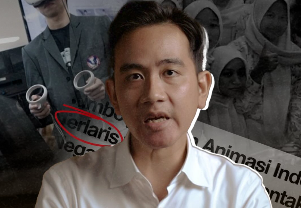
Frequently advocating for AI, Vice President Gibran Rakabuming Raka has repeatedly emphasized the superiority of individuals who utilize artificial intelligence. On the other hand, he also praised the film Jumbo, which gained significant popularity and happens to be a locally produced animated film created without the help of AI. This raises the question: are the Vice President’s statements inconsistent and at odds with the reality on the ground?
It’s not magic, nor sorcery—but innovation and technology that have made everything almost instant. Tasks that once required significant time, effort, and lengthy processes can now be completed within seconds. It is undeniable that the use of artificial intelligence (AI) is becoming increasingly widespread across society. People from all walks of life can now access it easily, whether for simple tasks or complex undertakings. Given the growing influence of AI, Indonesia’s youngest Vice President, Gibran Rakabuming Raka, has been vocally promoting the importance of adapting to and embracing AI. In various public forums, he encourages young people to become familiar with AI from an early age in order to stay competitive on the global stage.
Turning words into action, Gibran stressed that AI education should begin as early as primary school, including the integration of AI into the national curriculum starting from the upcoming academic year. “A few days ago, we held a closed meeting with the Minister of Education. Starting next academic year, we’ll begin incorporating AI lessons into the curriculum for elementary, junior high, and high schools,” he stated during a Studium Generale titled Creative Job Opportunity with AI at BINUS University on Friday (May 2).
Many in the public view this as a progressive move to prepare future generations for the challenges of a tech-driven world. However, others question whether Indonesia’s educational infrastructure is ready for such a leap, considering it an ambitious goal that may be difficult to implement evenly across the nation.
One widely discussed moment came when Gibran’s remarks about the importance of mastering AI were broadcast by the Vice Presidential Secretariat. “AI will not be a threat; it will not replace humans. But humans who do not use AI will be defeated by those who do,” Gibran said in a video aired by the Secretariat on Saturday (April 19). His support for AI was also evident when he attended and voiced encouragement for the AICO (Artificial Intelligence Community), a youth-driven initiative dedicated to learning and developing AI.
Public reactions grew more skeptical when Gibran released a video titled “Youth Generation, Demographic Bonus, and Indonesia’s Future” on his YouTube channel. Many netizens speculated that AI tools were used in its production. The response was swift—flooded with dislikes and sarcastic comments. Ferry Irwandi, a popular digital creator, even made a parody version of the video, mimicking its tone, diction, and visuals while subtly satirizing Gibran’s delivery.
V as viewer shared her critique of the video, “As a Gen Z viewer, I found Gibran’s delivery stiff and emotionally flat. The visuals and audio were decent, but the lack of supplementary visual elements made the video feel monotonous,” she said.
also pointed out a contradiction in Gibran’s statements, particularly regarding his praise for the animated film Jumbo. “Gibran wants to highlight the importance of youth leveraging AI to take advantage of the demographic bonus, yet he praises Jumbo, a film that succeeded without any AI assistance but still resonated widely with audiences. That message feels contradictory and inconsistent,” she explained. She further noted that Gibran’s statements should not exist in a vacuum. His claim that “those who don’t use AI will lose” is a predictive one—implying that technology will be the sole determinant of future success.
However, the success of Jumbo proves otherwise. It highlights that creativity and human emotion—elements not easily replicated by AI—continue to hold immense value. Gibran seems to overgeneralize the role of AI, focusing primarily on best-case scenarios and implying that everything must submit to technology. In reality, social and cultural dynamics often show resistance to such change, preserving the authenticity and emotional depth in human-created art that sets it apart from machine-generated outputs.
Gibran’s praise for Jumbo, shared in his YouTube monologue, drew particular attention. “Recently, I watched Jumbo, an animated film by young Indonesian talents. It has already surpassed four million viewers and is set to be screened in 17 countries across Asia and Europe. This marks a new era for Indonesia’s animation industry,” Gibran said.
This acknowledgment adds complexity to the conversation. Gibran’s statement that “those who don’t use AI will be left behind” is seemingly contradicted by Jumbo’s success. According to Tempo.co, the film garnered over 7 million viewers in less than 30 days, becoming one of the most successful Indonesian animated films of all time. This achievement challenges the notion that AI is a mandatory element for success, showing that homegrown talent, even without AI, can thrive both domestically and internationally.
On one hand, Gibran fervently advocates for the importance of AI adaptation and usage. On the other, he praises a creative work that demonstrates humans are not necessarily outclassed by technology. This inconsistency invites public scrutiny: Is AI truly an absolute necessity in every creative and educational process, as Gibran has often implied? Or might excessive reliance on AI diminish critical reflection and human intuition?